
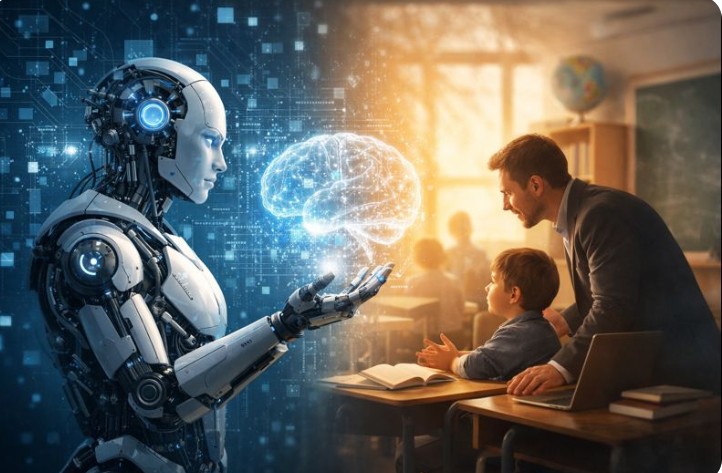
Between Technical Competence and the Human Dimension:
Problems of the Educational Role in the Age of Artificial Intelligence
Dr: Moussa Djokhdem
Faculty of Economics, Business and Management Sciences
Amar Telidji University of Laghouat – Algeria-
Abstract:
The education sector is currently undergoing radical transformations due to rapid developments in the field of artificial intelligence. Smart algorithms have become one of the main drivers reshaping the educational structure and the roles of educational actors. The role of the teacher has shifted from being a lecturer and transmitter of knowledge to a facilitator of learning and a strategic guide who helps learners leverage technological capabilities to build their own expertise. Machine learning algorithms and big data analysis have also contributed to a qualitative shift towards personalized education, by designing learning paths that adapt to learners’ abilities and interests. This has enhanced the effectiveness of the educational process, raised student engagement, and enabled self-directed learning..
Conversely, these transformations pose challenges related to the human dimension of the educational process, such as the risk of reducing the teacher’s role to a technical aspect and weakening their value-based educational role. There are also concerns related to overreliance on algorithms and the inherent biases they may carry. Hence, the need for a balanced approach that leverages the advantages of artificial intelligence to enhance the quality of education, without ignoring the importance of the teacher’s human role as a guide and facilitator of critical thinking and human values..
This emerging reality requires a restructuring of the educational philosophy and the development of educational governance frameworks capable of effectively integrating algorithms into the modern educational environment, ensuring a balance between technical efficiency and the human dimension, and paving the way for building a more comprehensive and innovative educational model..
Keywords:Artificial intelligence, educational algorithms, educational roles, digital learning environment, educational transformation
Introduction:
Are culture and artificial intelligence applications the solution to address our growing educational problems in our Arab world in light of the challenges we face at the level of teachers, curricula, and…IEducational strategies, classroom and extracurricular activities, school equipment, and the educational outcomes that accompanied these problems were developed.AArab countries dominated the last part of the global ranking of the tests (PISA) internationalAEvaluated in the year “2022 AD”?
The technical innovations and smart websites that have been produced by artificial intelligence applications constitute a qualitative shift in the updates and changes to the inputs and operations in the teaching and learning process, which will necessarily result in changes in the educational outcomes, both positive and negative!!!
The educational institution stands at a crossroads in the era of artificial intelligence, as the function of the teacher, student and school has been severely shaken in all its processes, levels, theories, laws, activities, effectiveness, problems and uniqueness of education. Therefore, this study came to address the educational changes in the teaching and learning process in light of artificial intelligence algorithms by answering the following main question:
What is the impact of artificial intelligence algorithms in bringing about educational changes in the teaching and learning process?
- The following sub-questions arise from this main question:
- What is the concept of artificial intelligence?
- What is the impact of artificial intelligence algorithms on the teacher?
- What is the impact of artificial intelligence algorithms on the student?
- What impact will AI algorithms have on curricula?
- What is the impact of artificial intelligence algorithms onITeaching strategies?
- What is the impact of artificial intelligence algorithms onIEvaluation strategies?
- What is the impact of artificial intelligence algorithms on classroom and extracurricular activities?
- What is the impact of artificial intelligence algorithms on educational methods?
- What is the impact of artificial intelligence algorithms onAtoIClassroom?
- What is the impact of artificial intelligence on theIRashad in the educational institution?
- What challenges and risks will education face in the era of artificial intelligence?
Study method:The study used the descriptive analytical approach.
Importance of the study:The importance of this study lies in its treatment of the topic at hand, which will constitute a major challenge.toFor the educational institution in its inputs, processes and outputs throughout the current decade and whatforCount it through the tremendous implications of artificial intelligence on the education process, content creation, question bank, test analysis and construction, andITeaching strategies and their effectiveness, andIClassroom management and everything related to the teaching and learning process directly or indirectly.
The concept of artificial intelligence:-
For the novelty of the topic andIIts dynamically growing status has multiplied definitions and different perspectives to unveil a definition that includes all the relevant aspects, but the ambiguitywhatIt is still prevalent and the most prominent modern definitions can be presented as follows:
- Intelligence built by machines and programs that mimic human mental abilities and working patterns, such as the ability to learn, reproduce, and react to situations that were not programmed into the machine.
- Systems that use technologies capable of collecting and using data to predict, recommend, or make decisions with varying levels of autonomy, choosing the best course of action to achieve specific goals.
- The simulation of human intelligence processes by machines, especially computer systems.
Through these definitions and others, we find that the concept of artificial intelligenceattempt toSimulating human intelligence in analysis andIDark and logic, decision-making, problem-solving and alternatives. Accordingly, artificial intelligence can be defined in this study as: – Machine intelligence that simulates human intelligence in analysis, forecasting, data collection and problem-solving.IIssuing judgments at increasing levels with the advancement of science.
The importance of artificial intelligence in education :
Artificial intelligence is one of the outcomes of the unprecedented technological revolution that has recently grown, and which will receive…YIts shadows on all inputs, processes and outputs of the teaching and learning process in terms of enhancing theICreativity, saving time and effort, improving the educational process, taking into account individual differences, enhancing self-learning and unleashing energies, making education more enjoyable, and addressing some of the difficulties and challenges that some students suffer from in languages and slow learning, in addition to theIThe enormous potential that the teacher will provide in preparing and correcting tests, monitoring and analyzing marks, andIThe effective classroom circuit, achieving the greatest amount of communication and contact between the educational institution and the home, building content and curricula, quickly modifying and developing them, and helping to discover trends, inclinations, and value orientations, and other matters that are steadily developing towards the better and the best, in addition to the other side that will carry within it complex challenges, various problems, and extreme difficulties that will be addressed at the end of this study.
The impact of artificial intelligence algorithms on the teacher:
The role of the teacher in the era of artificial intelligence is changing steadily, and the teacher’s ability to keep up with technological developments and successive artificial intelligence applications poses a real challenge to him. Artificial intelligence programs and developments have begun to enter the classroom to help the teacher in all the work he does, whether administrative or technical. The following are the most prominent things that these algorithms will help us with:
- Administrative work:Most studies show that20%-15% of the work done by the teacher is administrative, such as taking attendance and absence, being late to class, filling out and analyzing grades, conducting longitudinal studies, determining students’ tendencies and inclinations, and measuring their mathematical, literary, and scientific abilities in light of their results over the course of their previous years of study to form an educational perspective on the mechanisms for dealing with them and advancing them, and addressing their weaknesses and enhancing their strengths in light of the analyses provided by artificial intelligence software and its tools.
- Correcting tests:It is known that what consumes a large part of the teacher’s time is the process of correcting papers or tests, whether they are multiple choice or essay choices. Artificial intelligence algorithms have dealt with this matter and shortened it in an automated manner that is incomparable with the effort and time of traditional correction.
Perhaps one of the most prominent applications of artificial intelligence in automating the correction process for paper tests and obtaining immediate results with unparalleled accuracy is the (Remark Office) program.Remark Office).
- Daily, quarterly and annual planning:The teacher spends long periods of time completing these tasks in addition to the physical and mental effort that accompanies the completion of the task, while artificial intelligence algorithms, through their various applications, shorten the time and effort in completing these tasks more accurately, with broader analysis, and deeper conclusions, while providing high flexibility.
- Design of media and activities:The development of educational tools and methods in light of artificial intelligence algorithms will provide interactive educational programs, andAsalivaOhAn interesting educational environment, rich and stimulating through educational robots, virtual reality and augmented reality integrated with artificial intelligence software, which enhances the learning, participation and understanding process more accurately and easily in a realistic, interactive, exciting and enjoyable environment.
- Sustainable education:Artificial intelligence applications will provide the largest wave, teacher and facilitator for the teacher to guide students to critical thinking, problem solving, brainstorming, self-learning and its skills according to their abilities, tendencies, needs and orientations in anticipating the future, and learning through projects.
- Contact and communication:According to a surveyAMcKinsey & Company conducted a study in partnership with Microsoft in a number of countries that showed that teachers work the equivalent of (50) hours.AWeekly, and they spend 49% of the total number communicating directly with students, which may lead to the inability to provide the required performance, and the difficulty of following up on students individually. Which may negatively affect the desired results of the learning process (1);Thanks to the use of artificial intelligence applications, this time has been reduced to a fifth through theIAnswering traditional questions, providing immediate solutions to questions, correcting answers, re-explaining and clarifying, providing students with enrichment questions, therapeutic explanations, constructive questions, andAInteractive games, and more that these algorithms provide.
- ITeaching strategies:Artificial intelligence algorithms help the teacher chooseIThe appropriate teaching strategy in light of the analysis processes it provides in terms of learning styles, determining the students’ prior learning level, and the strengths and weaknesses in the process of individualizing education. It also helps in planningICircuitITeaching strategy in terms of formulating cognitive and skill questions, value orientations and enhancing attitudes.IPositivity and cooperation among members of the same class during the educational situation.
The impact of artificial intelligence algorithms on the student:
Artificial intelligence innovations have begun to make a difference in the educational process at the level of individualizing education for each student; determining the student’s level of knowledge and skills and drawing up a plan for advancement and excellence or addressing previous and current imbalances has become more available than ever before in a safe, stimulating and interactive environment in which the student enjoys a kind of privacy and the initiative to engage in self-learning, and is far from shyness and external influences that make him refrain from practicing education and its continuity.
Repeating the explanation of information, formulating it in different ways based on interactivity and enjoyment, and progressing from prior learning to anticipating the future, passing through current learning, constitutes an important axis of the work of artificial intelligence.NI understand at the student level; the teacher does not have enough time to answer students’ questions and inquiries at different levels, while artificial intelligence software and its technological innovations, such as robots and others, constitute essential tools in bringing about a qualitative shift in the learning and teaching processes.
To revolutionize the latent energy of students and increase motivation towards learning, and allocate educational programs, andAInteractive games that take into account the learning style of each individual student constitute the cornerstone in the process of advancing the teaching and learning process during the decade.the thirdFrom theAThe third roll.
Also, internalizing the scientific method of solving problems and issuing decisions after collecting and analyzing data, and studying the proposed options and their alternatives will gradually enable the student to advance and keep up with the times, prepare for the test of his future job, and stay away from professions that will become extinct or that are on their way to becoming increasingly extinct.ADisappearance
Artificial intelligence software provides students with open learning opportunities, listening to lectures and experiences of the best teachers in the world without language being an obstacle to learning, whatever it may be, as a result of the tremendous progress in high-quality instant translation programs that are constantly evolving.
The impact of artificial intelligence algorithms on curricula:
The current curricula will witness radical transformations within the next few years because the basis for their construction will be the student’s level and abilities, and the paper curricula will lose their spark, and will even disappear at an unexpected speed!!!
Artificial intelligence software, its smart links and its technical innovations will rebuild the content in the curricula to be more interactive and enjoyable, and have a deeper impact in improving self-learning, accuracy of understanding, speed of learning, skill development, and improving the evaluation and assessment process and early detection of students’ response levels to questions and activities of educational curricula in their new technical form, which is necessarily reflected inIIn response to a systematic and effective assessment that keeps pace with developments, addresses real problems, and looks to the future in a flexible, scientific manner that works to improve the quality of learning and education.
What distinguishes the courses in the age of artificial intelligence is that these courses are interactive, constructive, and vertically and horizontally integrated with other subjects and courses.
What distinguishes the courses?IElectronic in the era of artificial intelligence, the speed of its modification, development and improvement, the provision of scientific resources, therapeutic and enrichment activities, interactive games and progressive assessments, and the use of virtual reality and augmented reality, which supports the learning process by immersing students in realistic and virtual environments that support the educational process in an increasing manner.
The impact of artificial intelligence algorithms onITeaching strategies:
Moving the educational learning process fromIDirect teaching strategyIA single and unique strategy has begun to fade as a result of the use of artificial intelligence software inside the classroom, as this software helps the teacher choose theIThe most effective strategy for student learning according to his abilities, inclinations and learning style, so that the educational situation has more thanIStrategy distributed to all students,Defining groups in cooperative learning is done through this software that maintainsIFinding equivalent and integrated groups, and achieving theAGoals and targeted outcomes.
Also, employmentITeaching strategies such as project-based learning are done by providing students with data, key steps to work on, andIfor meIConducting comparisons, analyzing data and distributing work, helping to formulate the problem, defining its questions, making use of the proposed data collection methods and proposing expected solutions toATest and generalize it.
Improving the learning process through the use ofIThe teaching strategy appropriate to the educational situation is done through artificial intelligence software that determines theIProcedures required for employmentISelected strategy and phased and time planningandDetermine theAEducational tools, resources and methods that can be used, and asking preliminary, constructive and concluding questions to determine the effectiveness of theIStrategy or notIStrategies used to achieve the learning process.
The impact of artificial intelligence algorithms onIEvaluation strategies andAIts inkwell:
These algorithms represent a revolution in assessment strategies and tools in terms of documentation, analysis, speed of correction, monitoring of marks, reading data and expressing it descriptively and numerically, and formulating plans.IEnrichment or therapeutic in light of these results accurately and quickly at the individual and collective level for members of the same classroom, And compare it with the results of similar classes.
These algorithms also help the teacher, through data analysis, to monitor learning gaps at the student and group levels early, which facilitates the process of closing these gaps and increasing self-confidence among students.IApproaching the learning process with positivity and high motivation.
These algorithms help the teacher by providing the learner with constructive activities and exercises that address his gaps in a systematic and cumulative manner and expose him to constructive assessments to ensure that he possesses the knowledge and skills necessary to avoid these gaps, which enhances the teaching and learning process and moves it forward on both the collective and individual levels.
Digital assistants for teachers (such as robots or some artificial intelligence sites)AAn effective tool inIReading, writing, speaking, listening and essay writing tests.IGrow in different languages, and monitor theAErrors and analysis, proposing programs and solutions, following up on their implementation, and providing the teacher and learner with feedback on inputs, processes, outputs, homework, andAActively targeted to address and improve in a way that combines accuracy, saving time and effort, and providing a kind of privacy for the student to address his educational imbalances and gaps without embarrassment from his colleagues and peers inside the classroom.
With the development of artificial intelligence software and tools, it has become easy for the teacher to detect theAStolen or transferred researchIAdditionITo evaluate and record its marks, and provide the learner with the necessary notes and recommendations in light of the agreed-upon standards, which supports the learning process by providing feedback..
The impact of artificial intelligence algorithms on classroom and extracurricular activities:
Classroom and extracurricular activities are considered an essential element of the teaching and learning process. Classroom activities achieve cognitive, emotional and motor integration of the learner. It enhances the consolidation of information and the mastery of the skill of thinking in innovative ways, andIMastering the skill in a creative way enhances the student’s balanced personality, unleashes his latent energies, and increases his accumulated experiences.
Artificial intelligence algorithms have provided cognitive and skill activities that develop students’ knowledge and skills in an interactive manner, in addition to integrating the virtual environment with the real environment, employing augmented reality with artificial intelligence software to achieve quality education based on solving problems and anticipating the future, and revolutionizing the latent energies of students to transform theoretical knowledge into applied knowledge in engineering, science and mathematics tracks, and gradually preparing students for future professions, and moving away from professions that are on the way to disappearing and fading to maintain the continuity of development and modern construction that keeps pace with all technological developments, and growing artificial intelligence software.
On the other hand, extracurricular activities enhance social normalization processes, spread modern technology in society, and help institutions and community organizations to advance technically and employ artificial intelligence algorithms in their work and programs and train their employees to advance the institution and its operations.
There is no doubt that employing robots in extracurricular activities enhances students’ skill capabilities, andITheir placesIInnovative ideas that enhance their engagement in future jobs and their digital innovations, and their programs related to this new digital reality, while striving toIFinding activities that achieve a balance between integrating digital innovations with physical effort and targeted motor activity to maintain the health of society and combat the negative effects of digital products such as obesity, autism, introversion, and other visual, auditory, and motor diseases resulting from prolonged use and distance from social activities.
The impact of artificial intelligence algorithms on educational media:
AI algorithms provide new innovative ways to enhance From the learning and teaching process, chatbots and AI-based websites work on students’ linguistic fluency, andGain themNew knowledge, phrases and terms that enhance the ability toIMastering languages and speaking them while saving time and effort, and benefiting from these means and interacting with them in aIPositive andIInnovativeDulingo, for example.
Sports, art and science websites built on AI algorithms provide interactive environments that stimulate learning and enhance enjoyment.IPositive and including (ALEKS) for mathematics and Coursera for courses and more.
The impact of artificial intelligence algorithms on classroom management:
The successive developments of technological innovations based on artificial intelligence software have given a new concept to effective classroom management in terms of:
- Students sitting in the front seatsAnd find a role system forIAs a result of the necessary modifications to it through cameras that contain artificial intelligence programs that determine the extent of the student’s attention in the different classes, and thus reactivate the turn system according to the student’s tendencies, interests, distraction and preoccupation within the classroom at the level of academic subjects and other factors and distractions; so that the students and their seats are numbered and a picture is sent via mobile devices in addition to a picture showing the students sitting in their places that were determined by the artificial intelligence programs.AArtificial.
- Students’ attention to the lesson:Smart cameras send audio messages to a headset installed in the teacher’s ear about the student’s level of concentration with the teacher, the minutes of his mental distraction or his preoccupation with his phone or…, which helps the teacher control the students’ behavior inside the classroom, and direct their attention to interact with the classroom situation positively, withIThe possibility of sending some of these recordings to parents to guide their children to follow the class and the teacher and not to be distracted by anything that would distract them from the learning and teaching process in the future.
- Classroom environment:Smart digital vacuums have been designed to clean the classroom as soon as students leave the room in preparation for the next class.TIn front of other students, artificial intelligence software also controls the room temperature, and opens and closes the curtains automatically, taking into account natural factors and the classroom environment.
- Monitoring students’ performance in tests:Artificial intelligence software helps through the same smart camera – which we talked about – connected with traditional cameras to analyze data and provide a detailed report about each student, and the extent to whichAHis commitment, self-control and attempts to cheat – if any – and recording these operations with sound and image to benefit from them in the future in modifying negative behaviors and enhancing positive behaviors, which helps in building sound values and attitudes.
- Convert voice commands into digital data:Smart cameras capture students’ responses and teacher notes, and convert them into digital data that can be used to analyze the learner’s cognitive and skill abilities, attitudes, tendencies, and extent.AHis commitment to the administrative system and the core values of the educational institution, which helps in drawing up treatment and enrichment plans in the future, and determines the learner’s future orientations in a cumulative manner.
The impact of artificial intelligence algorithms on theIRashad Al-Madrasi:
Artificial intelligence sites and innovations workAArtificialOn completiontransferAndQuality in school educational guidance processes through the following:
- Smart Digital Guide:Several years ago, some interactive websites were activated that were designed in light of artificial intelligence algorithms.AArtificial intelligence to listen to students and analyze their educational and teaching problems in a safe environment where the student can speak frankly and with high transparency, which helps artificial intelligence to propose effective solutions, suggestions and recommendations, and follow up on them periodically to determine the treatment steps and make the necessary adjustments to the proposed treatment plan while taking into account privacy and complete confidentiality.
- Presenting and analyzing data and providing insights, suggestions and recommendations for each individual case:Analysis of the data available about the student in his fileIElectronically and in his interactions on social networking sitesIThe internal university and re-classifying it and providing it with questions and suggestions helps the educational counselor to address behavioral problems and propose appropriate solutions quickly and with high professionalism, which helps the counselor in his work and makes it easier for him to target new groups of students for what is called preventive treatment and to devote himself toIAs a result of studies and research at the student level to improveATheir constant support and encouragement, and addressing the problems that hinder their academic path in a scientific and systematic manner.
- Robot or human guide:Robots are still in the early stages of their life, and their successive generations carry many improvements and modifications through which some of the shortcomings and problems resulting from operation are addressed, but the question that arises is:
Will robot guides replace humans within the current decade?
The reality is that absolute interactivity with feelings andAFeelings, body language, andforThe depths of the human soul, and the revelation of its secrets.AHer secretsStillIn many aspects, it is ambiguous and requires in-depth studies and qualitative research that casts its shadow on the answer to this question that is being asked, which will most likely remain asked throughout this decade and the decade that follows it, so that we reach an effective educational advisor assistant within the near future period, except that replacing the absoluteStillOut of reach.
Challenges and risks that education will face in the era of artificial intelligence:
There is no doubt that the successive developments in building robots that operate with artificial intelligence or developing some sites and applications that employ this intelligence will bring about a qualitative shift in all educational and teaching levels, including…ANoAIt will also carry many challenges and will produce many problems, the most prominent of which can be summarized as follows:
- Gradual loss of human contact and socialization:Immersion in the digital world and the use of artificial intelligence in all aspects of the teaching and learning process will necessarily affect students’ psychology in terms of empathy, social construction, emotional intelligence, feelings of love, loyalty, cooperation, integration, collective feeling, and the reinforcement of negative traits, self-absorption, andANaniya and uniquenessAIntroversion, and the gradual abandonment of the societal value system.
- APrivacy Violation:The ability of AI algorithm owners to access and analyze data about theAPeople and institutions are superior and growing, so many of these institutions have sold this data to giant websites to use it in marketing and product promotion operations or for security, political or electoral reasons without referring to their owners directly, and pushing them to agree due to their monopoly on some applications and allowing their use after obtaining approval to access the data, phone camera and saved files!!!
- Classism in education and lack of equal educational opportunities:Countries and individuals who possess this softwareThey learnThey will have easy access to knowledge, data and their analysis, while others will suffer.AAnd those who do not have it will widen the gap between the rich and the poor in terms of exposure to educational experiences, knowledge and skills due to the lack or weakness of the financial ability to provide these algorithms or the infrastructure that serves these software.
Reducing many functions:Many educators fear the growing extension of artificial intelligence at the expense of traditional functions in the educational institution, as the functions of the measurement, evaluation and school testing departments will be reduced.Agradually to zero,andArtificial intelligence algorithms automate most of the tasks performed by these machines.AQassam, in addition to reducing the number of employees in human resources, the office, the secretariat and the control departments.TQuality, student affairs, graphic design and other professions that support the teaching and learning process will be on the way to rapid extinction, not on the level of decades but on the level of years, and this is what was warned about.From him in AEurope, China and the United States.
- Intellectual stagnation among students:The educational learning process before the emergence of artificial intelligence algorithms was characterized by the technology of thinking skills, observations, analysis, classification, synthesis, decision-making and generalization. ,….., but in the age of artificial intelligence, it has become one of the tasks of these algorithms, which will limit the mental fluency and higher thinking processes of learners, and this in turn will negatively affect subsequent generations, so that their thinking is confined to the box, and they gradually lose their ability to innovate and create. Therefore, the United Nations Educational, Scientific and Cultural Organization (UNESCO) published in September (9) 2023 AD a global guide to educational artificial intelligence in the field of education and research, which included a number of determinants, including:AThe age of thirteen is prominent.AndAs a limitAGet closer to using AI in the classroom.
Conclusion:
The successive developments, successive technical innovations and websitesIThe growing artificial intelligence-based electronic and its implications for the teaching and learning process pose a real challenge to the educational institution and its theorists to redraw policies and prepare training plans and programs that ensure the absence ofAThe spread of chaos and ambiguity in the education sector, and maintaining an educational philosophy and educational systemA cohesive organization that keeps pace with this growing technological revolution, employs its outputs for advancement, development and progress, and works to govern artificial intelligence algorithms within the educational institution to preserve its entity and control it.IIts impact or direction, and anticipate its effects. The study recommended the following:
- Conducting orientalist research on the effects of artificial intelligence algorithms and their various innovations on the educational system.
- Urging the United Nations Educational, Scientific and Cultural Organization (UNESCO) to hold an international conference to study the implications of artificial intelligence algorithms and their developments on the inputs, processes and outputs of the teaching and learning process.
- Directing researchers to study the negative effects of artificial intelligence algorithms on the ethical system and value orientations of learners and employees in the educational institution.
- Urging ministries of education and those in charge of teacher programs in universities to include some subjects related to artificial intelligence in the curriculum, especially practical and applied programs inside the classroom, to employ them and benefit from their outcomes.
the reviewer
- Arab Journal of Special Education,2021,Majld(7), No. (25), pp. 313-334
- Journal of Humanities and Social Sciences,2022,Volume (10), Issue (4), pp. 109-127
- Matousi, Henda Salem. Ammar, Haifa Ismail, 2022, The role of artificial intelligence in improving the quality of learning outcomes.
- International Journal of Online Education, Egypt,(July 31/ July 2020). Volume 19, Issue 1.
- Scientific Journal, University Education Development Center,2021,Ain Shams University, Egypt, Volume 52, pp. 561-597.
- Shubham, Joshi. Redha, Krishna. Prathamesh, Chury, 2020, Vol. 1714, 2nd International Conference on Intelligent Learning for Information Enhancement 2020 24-25 October,Goa, India.
- Nguyen, Andy. Ngan, Ngo. Evion, Hong, 2023, Taiwan, Ethical principles of artificial intelligence in education.
- Petros, Lamiras. Sylvester, Arnab, 2022, UK, Power to Teachers: An Exploratory Review of Artificial Intelligence in Education.
- net/aswaq/opinions/2023/04/15
- unesco.org/ar/articles/fy-alfsl-aldrasy-yib-alaw-ytjawz- aldahka-alastnay-hdwdh
- net/aswaq/opinions/2023/04/15
- unesco.org/ar/articles/fy-alfsl-aldrasy-yib-alaw-ytjawz-aldahka-alastnay-hdwdh
- https://www.alljazeera-net/tech/4/5/2016.
- https://sdaia.qov.sallar/SDAIA/about/pages/aboutALaspx
- https://mediam.com/@dana92351
- https//taelum.org

-
د. جخدم موسى- الأغواط – الجزائر
-
أستاذ محاضر صنف (أ)
-
جامعة عمار ثليجي – الأغواط، الجزائر
-
كلية العلوم الإنسانية والعلوم الإسلامية والحضارة
-
قسم علوم الإعلام والاتصال
-
متخصص في إدارة الأعمال
-
عضو الرابطة الدولية للباحث العلمي منذ 2019
-
عضو أكاديمية التدريب الشامل – السعودية منذ 2022
-
منسق كتاب جماعي بعنوان: الاتصال والثقافات الشعبية في الجزائر (2022)
-
عضو اللجنة العلمية للكتاب الجماعي نفسه (2022)
-
عضو مناقش في العديد من مذكرات الماستر (2018–2023)
-
رئيس لجان مناقشة مذكرات ماستر (2018–2023)
-
عضو الهيئة العلمية للمجلة الجزائرية لبحوث الإعلام والرأي العام منذ جوان 2022
-
عضو لجنة المراجعة بالمجلة الجزائرية لبحوث الإعلام والرأي العام منذ 20 جانفي 2023
-
محكم بمجلة المسار الرياضي منذ 2023
-
عضو اللجنة العلمية لمجلة المسار الرياضي منذ 2023
-
عضو لجنة علمية في الاستكتاب العلمي الدولي المعنون بـ الأسرة والثقافة التربوية (2024)
-
يهتم بحثيًا بإدارة الأعمال والأعمال الدولية، التسويق الرقمي، الإعلام والاتصال الإداري، الاتصال والثقافات الشعبية، الاتصال التسويقي، التطبيقات والبرامج الحاسوبية.
